Saturday, November 14, 2015

BANK NOTES

Tanzania Currency- Banknotes

The first banknotes in this country were rupee banknotes introduced in 1905 during the German rule. They were in denominations of  5, 10, 50, 100 and 500 Rupien. Their images are shown below. Very few the banknotes with face values of 500 rupee were issued because not many people could own as much as that amount of cash; I was unable to get their images.
5 Rupien
doa_5rupien.jpg
10 Rupien
doa_10rupien.jpg
50 Rupien
doa_50rupien.jpg
100 Rupien
doa_100rupien.jpg
In the same year of 1905, Zanzibari rupee banknotes were introduced in Zanzibar.  These were also in denominations of 5, 10, 20, 50, 100 and 500 rupees. However, up to this moment I have managed to get an image of the 5 rupee banknote only.5 Zanzibari rupee
zz10.jpg
During the first world war, the German government in German East Africa introduced emergency banknotes on plain paper. These emergency banknotes were in denominations of emergency notes were issued in denominations of 1, 5, 10, 20, 50 and 200 Rupien. The emergency 200 rupien banknotes were very few; I couldn’t get their images.
1 Rupie
doa_1rupiene_1.jpg
5 Rupien
doa_5rupiene.jpg
10 Rupien
doa_10rupiene.jpg
20 Rupien
doa_20rupiene.jpg
50 Rupien
doa_50rupiene.jpg
It seems that Tabora was the second important city after Dar es Salaam during the German rule as every banknote listed Dar es Salaam and Tabora cities. The temporary banknotes were very rudimentary, and at some time,  they were produced by just a mere rubber stamp as shown below.
A Rubber stamp temporary banknote
doa_1rupiene_3.jpg
After the fall of Germany rule in East africa, first, the British used the East African Rupee and the Zanzibari rupee along with the rupien. In zanzibar a 1 rupee banknote was introduced just after the war in 1920.
1 Zanzibari Rupee

zz1.jpg
1 EA Rupee
ea_1rupee.jpg
5 EA Rupee
ea_5rupee.jpg
1o EA Rupee
ea_10rupeeef.jpg
In mid 1920, the British government introduced a common east African currency of the East African Florin. Florin bank notes were in denominations of  1, 5, 10, 20, 50, 100 and 500 florins, with the 10 florins and above also carrying the denomination in pounds (1, 2, 5, 10 and 50). This currency did not last more than six months, so very few banknotes were released.1 EA Florin
ea_1florin.jpg
5 EA Florin
ea_5florin.jpg
After about six months, in .. 1921, the East African Shilling was introduced to replace the East African Florin. The EA shilling had a value of 20 EA Shillings per British Pound, and it was pegged to the pound. For that reason, all 20 EA Shilling banknotes had dual values, of 20 EA Shillings and 1 pound. All banknotes were written in English, Arabic and in Amharic. Two designs of the EA Shilling banknotes were issued; the first design lasted from 1921 to 1958 during the reigns of King George V(1910-1936), King Edward VIII(1936-1936), King George VI (1936-1952) and Queen Elizabeth II (1952-Todate). The face had a picture of the King and back had a picture of lion behind Mount Kenya.
Banknotes released released under King George V were in denominations of 5, 10, 20, 100, 1000,  and 10,000  EA Shilling
5 EA Shilling
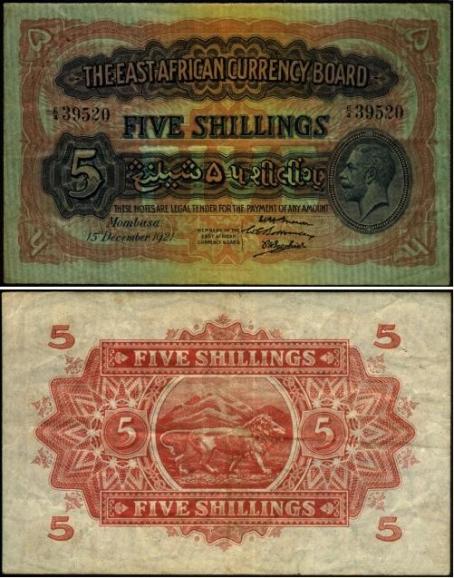
ea_5shsgeorge5.jpg
10 EA Shilling
ea-10shsgeorge5.jpg
20 EA Shilling
ea_20shsgeorge5.jpg
100 EA Shilling
ea_100shsgeorge5.jpg
1000 EA Shilling
ea_1000shsgeorge5.jpg
(Picture was taken after the banknote had been delegitimatized. Punched holes indicate the delegitimization of the banknote)
 By the value the shilling at that time, very few banknotes with a face value of 1000 and 10,000  EA Shillings actually circulated. I haven’t been able to get an image of the 10,000 banknote. In 1933, the 1000 EA Shilling bank note was retired from circulation.
During the short lived reign of King Edward VIII, no banknotes were released. The next release was under King George VI. Under King George VI,  the 1 EA Shilling was introduced in 1943 and the 10,000 EA shilling banknote was retired in 1947.

1 EA Shilling
ea_1shsgeorge6.jpg
5 EA Shilling
ea_5shsgeorge6.jpg
10 EA Shilling
ea_10shsgeorge6.jpg
20 EA Shilling
ea_20shsgeorge6.jpg
100 EA Shilling
ea_100shsgeorge6.jpg
After the death of King Gorge VI when Queen Elizabeth II took the throne, the first release of banknotes under the queen were similar to those of her predecessor, however the 1 EA Shilling banknotes were retired from circulation. It seems that this was the only banknote that carried a value of one shilling in East African history.

5 EA Shilling
ea_5shselizabeth2_1.jpg
10 EA Shilling
ea_10shselizabeth2_1.jpg
20 EA Shilling
ea_20shselizabeth2_1.jpg
100 EA Shilling
ea_100shselizabeth2_1.jpg
In 1958, the banknotes were redesigned to be more colorful with popular East African cash crops to represent East african economic activities than merely a lion and Mount Kenya. Denominations of 5, 10, 20, and 100 EA shillings were released. The 5 EA Shilling banknote showed cotton and cloves; the 10 EA Shilling showed sisal and tea; the 20 EA Shilling showed coffee and sunflower, and the 100 EA Shilling banknote showed coconuts, palms and pyre thrum. The East African shilling was no longer officially pegged to the pound, hence the 20 shilling banknote did not have dual values any more.
5 EA Shilling

ea_5shselizabeth2_2.jpg
10 EA Shilling
ea_10shselizabeth2_2.jpg
20 EA Shilling
ea_20shselizabeth2_2.jpg
100 EA Shilling
ea_100shselizabeth2_2.jpg
These new designs continued until after independence although by 1961, the number of members in the East African Currecy board had increased to 6 members, the banknotes released in 1961 had some slight modifications in the front face to accomodate six signatures of the board members as shown below.
5 EA Shilling

ea_5shselizabeth_2_3.jpg
10 EA Shilling
ea_10shselizabeth2_3.jpg
20 EA Shilling
ea_20shselizabeth2_3.jpg
100 EA Shilling
ea_100shselizabeth2_3.jpg
The first post-independence release of the EA Shilling banknotes in 1964 had significant changes. The notes were in English and kiswahili; the face of the British ruler was replaced with a dhow (the reason for choosing a dhow is not yet known); and the back of the banknotes were also carried the same east African cash crops although in different images as shown in the following pictures.
5 EA Shilling

ea_5shs.jpg
10 EA Shilling
ea_10shs.jpg
20 EA Shilling
ea_20shs.jpg

Tanzanian money during the british colonial

Tanzania Money:  (Coins-British Rule)

After the world war I in 1919, German East Africa was occupied by British and Belgian forces. In Tanganyika, the Rupie circulated alongside the British East African rupee, which had been in existence in Kenya and Uganda, until 1920 when both were replaced by the East African florin at par. The florin was divided into 100 cents. Coins were minted in denominations of 1, 5, 10, 25 and 50 cents and 1 florin but, according to the “Standard Catalog of World Coins” (C. L. Krause & C. Mishler, Krause Publications), the 50 cents coins were not released for circulation and only 30% of the 1, 5 and 10 cents coins produced were issued for circulation before the East African florin was replaced by the East African Shilling in 1921. One Shilling was equal to half a florin or equivalently one East African florin equaled two East African Shillings. Because of its short period in existence, few of the coins minted were actually issued and are consequently scarce today.  Unfortunately, I have not been able to get images of those coins.
The East African Shilling was decimalized into 100 cents. Coins were issued in denominations of 1 cent, 5 cents, 10 cents, 50 cents and the 1 Shilling. Coins of 1, 5 and 10 cents were holed bronze, while coins of 50 cents and 1 shilling were solid faced cupronickel. Of all coins in history of this country, these coins were the most stable in  design as they never changed for the whole period of over fourty years of british rule; they continued in circulation even after independence untill 1966. As the British rulers changed, the coin faces were also changed ro reflect the reigning British ruler without changing the coin design; coins with faces depicting past rulers continued in circulation. From the period from 1921 to 1936 when the British empire was ruled  by King George V, coin faces appeared as follows.
Bronze coins
geoge5a.jpg
cupronickel
george5b.jpg
After the death of King George V and the start of the rein of King Edward VIII, who ruled for a little less than a year from January 1936 to December 1936 before being abdicated from the throne for his controversial marriage to an American divorcee Wallis Simpson. Only bronze coins were released during his reign and were inscribed as follows.
edwardviii.jpg
King EdwardVIII was replaced by King George VI who ruled until his death in February 1952. During the reign of King George VI, two designs of coin faces were issued. Coins released in the period from 1936 to 1946 were inscribed GEORGIVS VI as shown in the following pictures.
Bronze
gerge6ia.jpg
Cupronickel
george6ib.jpg
After 1946,  coins were inscribed GEORGIVS SEXTVS as shown in the following picture.
Bronze
george6iia1.jpg
cupronickel
george6iib.jpg
King George VI died in 1952 leaving the throne to his daughter, the current Queen Elizabeth II. Coins released under the reign of Queen Elizabeth II were inscribed as shown in the following picture.
Bronze
elizabeth2a.jpg
cupronickel
elizabeth2b.jpg
The back face of the coins never changed, all were as shown in the
following pictures.Back Bronze

bronze.jpg
Back Cupronickel
cupronickel.jpg
After independence, these coins continued in circulation as shown in the following picture.
uhuru1.jpg
However, in 1964 new coins were released without inscription of the British ruler. Typical coins released in 1964 were as shown in the following pictures.
uhuru2.jpg