The central feature of the Coat of Arms is a Warrior’s Shield which bears a Golden portion on the upper part followed underneath by the United Republic of Tanzania flag and a red portion under which are wavy bands of blue and white. The Golden portion represents minerals available in the country; the red portion underneath the flag symbolizes the red soil of Africa; while the wavy bands represent the land, sea, lakes and coastal lines of Tanzania. Superimposed features on the Shield are flames of a burning torch which signifies freedom, enlightenment and knowledge; a spear signifying defence of freedom and crossed axe and hoe being tools that the people of the United Republic of Tanzania use in developing the country. The Shield is set upon a representation of Mount Kilimanjaro. On each side of the Shield there is an elephant tusk supported by a man on the left and a woman on the right. At the feet of the man is a clove bush and at the feet of the woman is a cotton bush, thus indicating the theme of co-operation. The United Republic of Tanzania motto “Uhuru na Umoja” is written in Kiswahili and it means “Freedom and Unity
Saturday, July 16, 2016

National Anthem
Tanzania was the first African nation to use the popular African song "God Bless Africa" as its anthem in 1961 when it was Tanganyika and was retained after union with Zanzibar in 1964. It is now also used by South Africa (as part of the current anthem) and Zambia (with different words), and formerly used by Zimbabwe, Ciskei, and Transkei. The version used in Tanzania is in Kiswahili (the official language of the country) and not in Sontonga's original lyrics of Xhosa.
God Bless Africa. Bless its leaders. Let Wisdom Unity and Peace be the shield of Africa and its people.
CHORUS: Bless Africa, Bless Africa, Bless the children of Africa.
God Bless Tanzania. Grant eternal Freedom and Unity To its sons and daughters. God Bless Tanzania and its People.
CHORUS: Bless Tanzania, Bless Tanzania, Bless the children of Tanzania
The Uhuru Torch
The Uhuru Torch symbolizes freedom and light. It was first lit on top of Mount Kilimanjaro in 1961. Symbolically to shine the country and across the borders to bring hope where there is despair, love where there is enemity and respect where there is hatred. Yearly there is the Uhuru Torch race, starting from different regions throughout Tanzania, to remind Tanzanians of their duty to jealously guard their cherished freedom, unity and peace.

National Flag
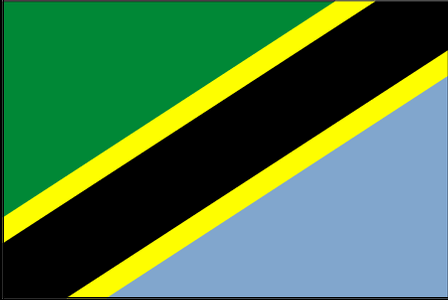
Tanganyika and Zanzibar merged to form a new republic on 26 April 1964, the name "Tanzania" being adopted on 29 October 1964. Like the name of the country, the new flag was a merger of that of its constituent parts. The lower green stripe of the former Tanganyika flag took the blue of the Zanzibar flag, and the stripes were re-arranged diagonally to give them equal status. The colour specifications are: Green Pantone 361c Yellow Pantone 116c Blue Pantone 299c These are, of course, rather standard shades of colours except for the blue, which is lighter than "normal" blue, but not as light as "light blue". Ratio length to breadth: three to two e.g. 3' x 2', 6' x 4', 12' x 8' Description: Green - Yellow - Black and Blue, having the black centre stripe centred on (the) diagonal raising from flag mast to top edge of the fly, two smaller yellow stripes dividing the upper triangle portion which is green and the lower triangle portion which is blue. Proportions of colours: Black centre stripe, centred on diagonal of flag of 6' x 4', is 13/48 of fly and 13" wide (my note - 4 feet = 48 inches). Yellow stripes are each 1/16 of fly and 3" wide. Colour code and significance: B.S. (referring to the British Standard Range of colours now redundant) No. 2660, 1955 Black BS No, 9-103 = the People Green BS No. 0-010 = the Land Blue BS No. 0-012 = the Adjoining Sea Yellow BS No. 0-002 = the Mineral Wealth

National Animal
The giraffe is Tanzania’s national symbol /emblem and, as such, it is protected by law. Though an exception decree can be granted by the president, for the most part, killing giraffes can result in jail time. The giraffe is a graceful animal whose long neck represents the ability to be visionary while still viewing the past and present. The giraffe reminds Tanzanians to increase their understanding by viewing life from all angles. The giraffe also reminds Tanzanians to use their strength and flexibility to align the physical, mental and spiritual as the giraffe

MY NATION II
History
The History of Tanzania started with the European Colonialists. The 8th century saw the growth of city states along the coast after settlement by Arabs as a nation from Oman. It was seven centuries later in 1499 that the Portuguese navigator Vasco da Gama visited the island of Zanzibar. Another 100 years later in the 16th century, the Portuguese occupied Zanzibar. Their occupation did not last for long as in 1699 the Portuguese were ousted from Zanzibar by Arabs of Oman who had returned to make it their own. So in the 18th century the Sultan of Oman reasserted Arab overlord ship of the East African coast, which became subordinate to Zanzibar.
By 1840 when Sultan Seyyid bin Sultan moved his capital from Oman to Zanzibar, trade in slaves and ivory flourished. In 1861, the Sultanates of Zanzibar and Oman separated on the death of Seyyid. During the 19th century, Europeans started to explore inland, closely followed by Christian missionaries. In 1884 the German Colonization Society began to acquire territory on the mainland in defiance of Zanzibar and 1890 Britain obtained protectorate status over Zanzibar, abolished the slave trade, and recognised German claims to the Mainland. German East Africa was formally established as a colony in 1897.
The 1905-07 Majimaji revolt was brutally suppressed by German troops. World events then took over with the outbreak of the First World War, and far as it was from Europe, German East Africa was not immune from the fighting, though effective fighting was short lived due to the successful 1916 Conquest of German East Africa by the British. In 1919, the League of Nations gave Britain a mandate to administer part of German East Africa, known as Tanganyika. In 1946 Tanganyika became a UN trust territory.
A Legislative Council was set up in 1926; it was enlarged in 1945 and restructured in 1955 to give equal representation to Africans, Asians and Europeans, sitting as 30 "'un-officials" with the 31 "officials". In 1954, a schoolteacher, Julius Nyerere, founded the Tanganyika African National Union (TANU), which promoted African nationalism and won a large public following campaigning for independence. The colonial authorities responded with constitutional changes increasing the voice of the African population while reserving seats for minority communities.
Elections were held in 1958 and again in 1960. The result was an overwhelming victory for TANU, which was by this time campaigning for independence as well as majority rule. The new government and British Government agreed at a constitutional conference in London to full independence for Tanganyika in December 1961. Zanzibar achieved independence in 1963 as a separate and sovereign country, under the al-Busaidy Sultan.
Tanganyika became a republic in December 1962, one year after achieving independence, and the direct presidential election brought TANU’s leader, Julius Nyerere, to the presidency. In 1965 the Constitution was changed to establish a one-party system. Meanwhile, in Zanzibar, a revolution had overthrown the Arab Sultan on 12th January 1964. One month after independence the Constitution was abrogated; Abedi Amani Karume was declared the first African President of Peoples’ Republic of Zanzibar and the country became a one-party state under the Afro-Shirazi Party.
On 26th April 1964 Tanganyika and Zanzibar united as the United Republic of Tanzania, with Julius Nyerere as President and the head of state, while Karume as his Vice President, retained at the same time the Presidency of Zanzibar. In 1971 Karume was assassinated in Zanzibar and Aboud Jumbe succeeded him as President of Zanzibar and Vice President of Tanzania. The political union between Zanzibar and mainland Tanzania has weathered more than four decades of change. Zanzibar has its own parliament and president.
In an effort to create socially equitable and rapid development, it became in early proponent of African socialism, Ujamaa (roughly meaning Togetherness), launched in 1967 under the banner of Arusha Declaration, with nationalisation of banking, finance, industry and large-scale trade, marketing through boards, and the resettlement of peasants in communal villages, Vijiji vya Ujamaa , created out of large estates
In 1977, the two ruling parties: TANU and Afro Shirazi Party, merged to form the Chama Cha Mapinduzi (CCM) which continues to rule the country after consecutive successful elections.
MY NATION
Tanzania profile
Tanganyika became a Sovereign State on 9th December 1961 and a Republic in 1962. Zanzibar became independent on 19th December 1963 as a constitutional monarchy under the sultan and the People’s Republic of Zanzibar was established after the Revolution of 12th January 1964. The two Sovereign States formed the United Republic of Tanzania on 26th April 1964.
The United Republic of Tanzania is a nation in East Africa bordered by Kenya and Uganda to the north, Rwanda, Burundi and the Democratic Republic of the Congo to the west, and Zambia, Malawi and Mozambique to the south. The country's eastern borders lie on the Indian Ocean.
The United Republic of Tanzania is a unitary republic composed of 30 regions. The Capital City is Dodoma and the major commercial city is Dar es Salaam. Official currency is Tanzanian Shilling and the National language is Kiswahili whilst English is widely used in official communication.
The name Tanzania is a portmanteau of Tanganyika and Zanzibar. The two states united in 1964 to form the United Republic of Tanganyika and Zanzibar, which later the same year was renamed the United Republic of Tanzania.
Moreover, Tanzania is one of the least developed countries which has great potential and prospects for attaining higher growth and development levels. The country is richly endowed with natural resources, pursues sound economic policies and has attractive investment policies. Tanzania is a vibrant democracy and the government is seriously committed to good governance, rule of law and respect for human rights.
